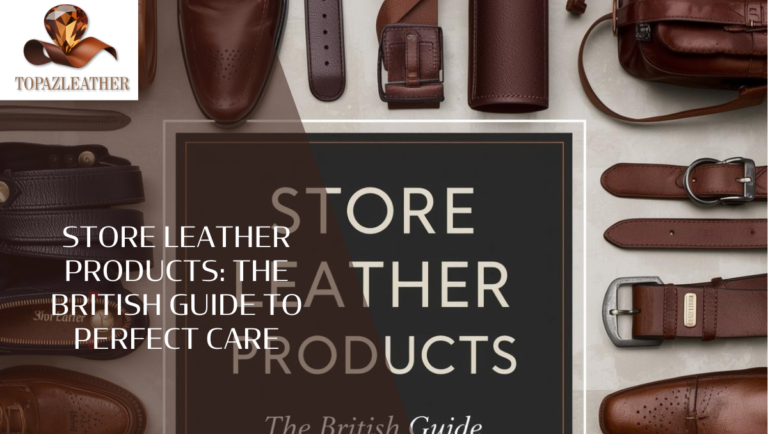
Store Leather Accessories Tips for Preserving Luxury For Life
Store leather accessories tips define whether premium leather ages with elegance or deteriorates through neglect. At Topaz Leather, we see storage as an extension of craftsmanship. Handmade leather reflects time, skill, and heritage, and correct storage protects that investment. British buyers increasingly value longevity, sustainability, and informed ownership, making it essential to understand Store leather accessories tips for anyone who owns belts, wallets, bags, or small leather goods.
Leather remains a living material even after artisans complete a piece. Fibres respond continuously to light, humidity, temperature, and pressure. When owners misunderstand these behaviours, damage follows quietly and often irreversibly. Education transforms storage from an afterthought into a discipline that preserves beauty and function. Authorities such as the British Leather Confederation (https://britishleatherconfederation.com) consistently emphasise care and knowledge as part of leather excellence, and this principle shapes our approach at Topaz Leather.
Why does improper storage damage luxury leather
Improper storage undermines craftsmanship. Sleatheraccessories tips exist because leather reacts to its environment. Excess moisture weakens fibres, while extreme dryness causes cracking. Direct sunlight fades dyes and dries oils that tanneries carefully preserve. Pressure distorts shape and structure.
UK consumer guidance from Which? At https://www.which.co.uk, storage errors are often highlighted as a leading cause of premature product failure. Luxury leather never fails suddenly. It deteriorates slowly through repeated mishandling, which makes education essential to protect premium accessories.
Ignoring climate control and humidity balance
Climate control influences longevity. When storing leather accessories, always consider humidity, as leather constantly absorbs and releases moisture. Damp environments encourage mould growth, while overly dry air strips natural oils.
The Leather Working Group at https://www.leatherworkinggroup.com promotes balanced storage environments as part of responsible leather stewardship. Topaz Leather advises owners to store leather accessories in stable indoor conditions that mirror everyday living comfort rather than extreme storage spaces such as lofts or basements.
Storing leather in airtight containers
Airtight containers suffocate leather. Store leather accessories in tips that discourage the use of sealed plastic boxes, as leather requires airflow to maintain fibre health. Trapped moisture accelerates deterioration and encourages mildew.
Museums that preserve historic leather artefacts, including the Victoria and Albert Museum at https://www.vam.ac.uk, store leather in breathable conditions that allow slow moisture exchange. This approach protects structure and surface over time and informs modern luxury storage practices.
Exposing leather to direct sunlight
Sunlight fades more than colour. Store leather accessories in a cool, dry place, away from windows, because ultraviolet rays degrade surface oils and weaken fibres. Even indirect sunlight gradually alters tone and texture.
The British Fashion Council at https://www.britishfashioncouncil.co.uk recognises material preservation as part of responsible fashion ownership. Luxury leather deserves controlled light exposure that respects the tanning process and the integrity of the dyes.
Hanging heavy leather improperly
Weight distribution matters. Store leather accessories with tips up, as gravity stretches leather over time. Belts hung from narrow hooks develop creases, while bags suspended without support lose structure.
Craft heritage organisations such as Heritage Crafts (https://heritagecrafts.org.uk) protect traditional leatherworking knowledge, including correct storage practices that respect the material’s behaviour. Topaz Leather designs storage guidance that aligns with these principles.
Folding leather accessories carelessly
Creasing becomes permanent. Store leather accessories with the tips down to discourage folding, as leather fibres compress and fracture under sharp bends. Wallets and belts require gentle curves that follow their natural form.
Leather technologists from the Society of Leather Technologists and Chemists(https://www.slct.org) explain how fibre memory influences long-term appearance. Respecting natural curvature preserves surface integrity and visual refinement.
Storing leather near heat sources
Heat accelerates degradation—store leather accessories away from air conditioners, fireplaces, and heated floors. Excess heat dries oils and stiffens fibres, leading to cracks and loss of flexibility.
UK consumer standards promoted by the Chartered Trading Standards Institute at https://www.tradingstandards.uk encourage safe storage that avoids unnecessary exposure to damaging conditions. Luxury leather responds best to moderation rather than extremes.
Neglecting cleaning before storage
Dirt attracts damage. Store leather accessories, and always include a light cleaning before storage, because oils, sweat, and debris attract moisture and bacteria. These contaminants accelerate breakdown during periods of inactivity.
Responsible care aligns with sustainability principles promoted by WRAP at https://wrap.org.uk, which encourages extending product life through maintenance rather than replacement: clean leather stores safely and ages with dignity.
Using incorrect dust covers
Dust covers protect surfaces, but the materials they’re made of are affected by dust. Store leather accessories tips recommend breathable cotton rather than synthetic fabrics. Plastic and non-breathable covers trap moisture and heat.
Luxury retailers and preservation experts follow museum-grade storage principles that prioritise airflow. Topaz Leather adopts these standards to guide customers toward informed care.
Overconditioning during storage
Excess care harms leather. Store leather accessories tips warn against overconditioning before storage. Too much conditioner saturates fibres and softens the structure excessively, which leads to distortion.
Leather industry guidance from trusted UK suppliers reinforces moderation as the key to longevity. Conditioning supports storage, but restraint preserves balance.
Ignoring shape support for bags
Shape defines luxury. Store leather accessories tips stress internal support for bags to prevent collapse. Soft filling maintains form without stressing seams.
British craftsmanship values structural integrity as much as surface beauty. Topaz Leather designs accessories that respond positively to correct support during storage.
Failing to rotate stored leather
Rotation prevents stagnation. Store leather accessories tips include periodic airing because leather benefits from gentle movement and environmental variation.
Heritage collections rotate stored items to prevent moisture concentration and fibre fatigue. This approach translates effectively into private luxury ownership.
Storing leather accessories together without separation
Surface contact causes transfer. Store leather accessories in a cool, dry place, and advise separating to prevent colour transfer and abrasion. Dark dyes can migrate, especially in humid conditions.
UK leather authorities consistently recommend separation as a basic preservation practice. Luxury accessories deserve individual consideration rather than collective neglect.
Using chemical repellents near leather
Chemicals compromise integrity. Store leather accessories in a place where mothballs and strong repellents are not used, as their fumes can alter leather chemistry.
Natural airflow and cleanliness provide safer protection, a principle supported by conservation experts across British heritage institutions.
Understanding leather as an investment
Education changes behaviour. Store leather accessories tips encourage owners to treat leather as an asset rather than a disposable item. Proper storage protects both emotional and financial value.
Topaz Leather creates accessories designed for decades of use, which makes storage knowledge part of the ownership experience.
British heritage and storage discipline
British craftsmanship values care. Store leather accessories tips reflect traditions of stewardship that define heritage manufacturing. Respect for material ensures continuity between generations.
Support from the UK Department for Business and Trade at https://www.gov.uk/government/organisations/department-for-business-and-trade highlights the global value of British-made quality. Storage discipline sustains that reputation.
Why luxury storage elevates everyday living
Luxury expresses itself through consistency. Store leather accessories tips that integrate seamlessly into daily routines rather than demanding excessive effort. Thoughtful storage enhances enjoyment and confidence.
Topaz Leather believes that luxury ownership includes knowledge, care, and pride—storage forms part of that narrative.
Preserve craftsmanship with Topaz Leather guidance.
Apply Store leather accessories tips that protect heritage, honour craftsmanship, and preserve premium leather performance. Connect with Topaz Leather for expert advice and handmade leather accessories designed to endure through informed care.
+447477227847
Hello@topazleather.com
www.topazleather.com
FAQs
Store leather accessories in tips to prevent moisture damage, cracking, and shape loss, thereby preserving their luxury quality.
Incorrect storage damages fibres and finishes, making storage tips essential for handmade leather.
Leather requires airflow, and Store leather accessories tips always prioritise breathable storage methods.
Sunlight fades dyes and dries fibres, which explains why Store leather accessories tips limit light exposure.
Periodic airing supports fibre health, and Store leather accessories tips recommend gentle rotation during long storage periods.